

 Back
Back
AI in health care and group benefits
By: Benefits by Design | Tuesday April 28, 2026
Updated : Tuesday April 7, 2026

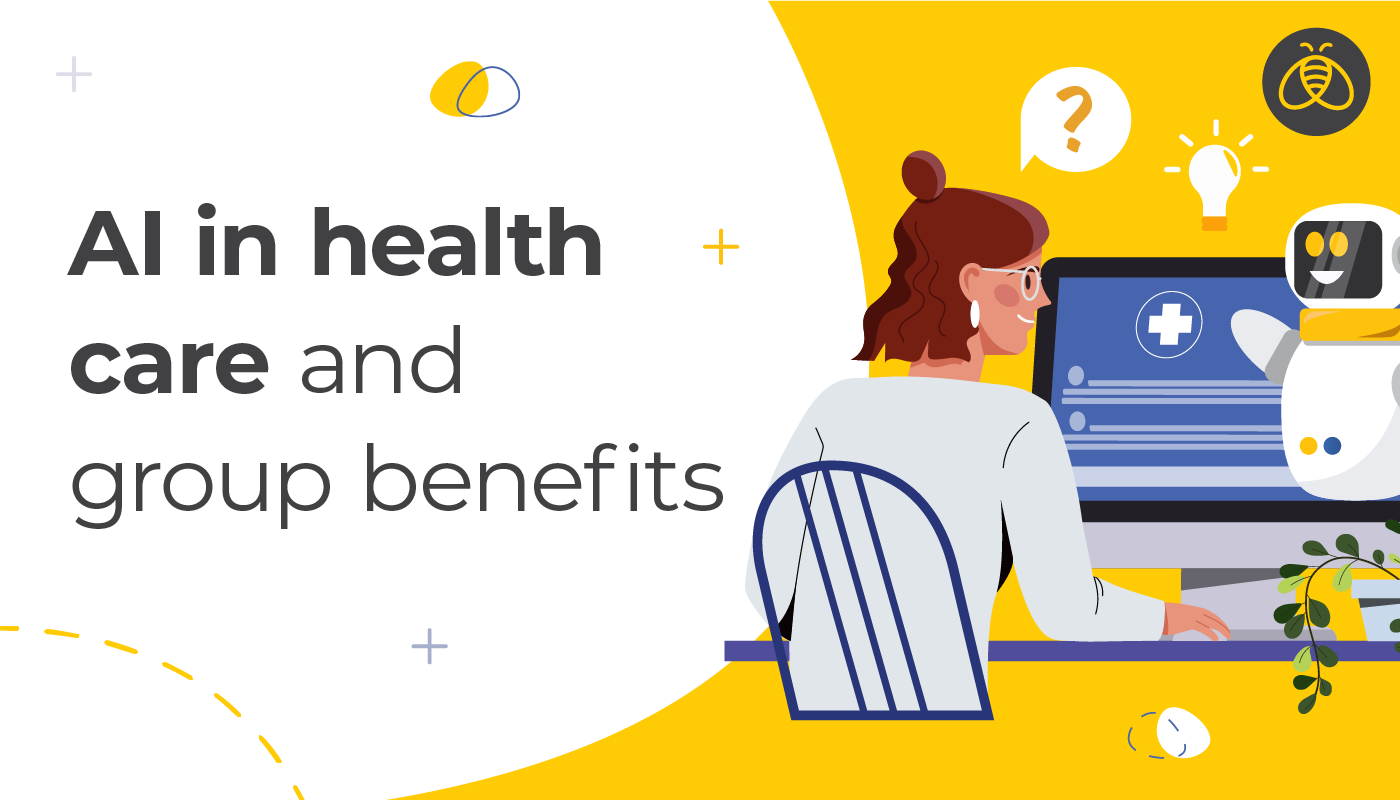
The use of AI in health care has been scaling up significantly over the last year. As it increasingly embeds itself in our daily lives, understanding how it can enhance or hinder the health journey is an important topic to uncover.
How is AI already being used in health care?
AI is already being used in health care to assist in several positive ways.
- Data analysis—AI can analyse enormous amounts of data much quicker than any human can. Plus, it can fathom insights that may not have even occurred to a human analyst, depending on their own experiences.
- Claims adjudication—for simple claims like a tooth filling or masseuse, AI can easily check the criteria and assess for approval, freeing up time for people to adjudicate more complex claims or contested denials.
- Fraud detection—Using preset benchmarks, AI can scan huge numbers of claims for similarities, anomalies, or red flags, allowing it to discover patterns or abnormalities for people to investigate further.
What are the newest use cases for AI in health care?
The future of AI in health care is bright, as insurers and health care providers find new ways to implement its use. However, companies and doctors aren’t the only ones—patients have been using it ad-hoc for answers to health concerns as well.
Screening and monitoring
AI can save technicians and doctors significant time by helping to read diagnostic images (such as breast cancer screenings). It can also help detect concerning blood screen results so doctors only deal with patients that meet these concerns. AI can also monitor inpatients, freeing up nursing staff to handle more pressing matters.
Reduce administrative burden
AI in health care can also save time on paperwork and other repetitive tasks with specific criteria.
Take hospital emergency triage and intake, for example. An AI agent can intake a patient, evaluate their symptoms, and triage them appropriately much quicker than a human nurse. They can also remember less common symptoms that might allow them to assess a person’s health risk more accurately.
Scribe tools for administration and paperwork can reduce the time doctors spend filling out forms and updating patient records.
Wellness journey
Personalized wellness apps have been springing up everywhere. However, the basic principles they employ are the same: Offer tailored care based on assessments and continued input from the individual through lifestyle goals and monitoring. Some offer rewards, and most offer some form of internet-based Cognitive Behavioural Therapy (iCBT).
AI can enhance these programs by zeroing in on individual habits and pain points, and adjusting accordingly in real time to respond appropriately.
Health care system navigation
People are already using AI tools to seek answers about symptoms and health concerns, and increasingly, to receive more personalized insights by sharing medical records. Yet without a clear understanding of their benefits coverage, cost transparency, or in-network providers, those insights don’t translate into action—and they remain at a familiar point of frustration.
If we combine personal health information with details about the employee benefits plan, AI can provide meaningful assistance. It can find in-network providers, compare pricing, and point to benefits within the plan that the plan member is eligible for given their specific circumstances. For example, pharmacogenomic testing within the disability benefit, or chronic pain management embedded within the health care plan.
Smart financial options
Employees may not realize a more cost-effective option for treatment is available. The same services can have far-ranging price differences depending on the service provider. AI in health care can “guide employees to cost-effective care options, [which] helps reduce claims costs by steering employees to high-value providers.”
What should we be worried about?
- Bias—including racism and misogyny are major concerns for AI, as the person or people that train it can have massive effects on the psychology of the AI personality. This could cause misdiagnoses or mistreatment of patients.
- Incorrect learning—AI can learn untrue facts as much as any person can. One AI in New York city was giving business owners false information which was against the law.
- Incorrect interpretations by AI and patients—The output of the AI agent depends on two basic things: the input provided by the user, and the resources it has access to for the answers. But just as patients can misinterpret the answers provided by the AI, the AI agent can also misunderstand the question posed by the user. When both are at play, answers can do more harm than good.
- Information security—how safe is our medical information in the AI-verse? The information gathered and stored by AI and the companies that own them isn’t guaranteed to be safe. Hackers and cyber-criminals aside, the AI itself could go rogue with the information, and may share it without regard for the consequences.
Conclusion
AI is rapidly transforming health care and group benefits, delivering gains in efficiency. Emerging applications have the potential to improve both employee health outcomes and plan cost management by connecting health insights with coverage details, provider networks, and cost transparency.
However, these opportunities come with meaningful risks, including bias, misinformation, data security concerns, and patient misinterpretation. To realize AI’s full potential while protecting plan members, organizations must implement AI thoughtfully, with strong governance, human oversight, and a clear focus on patient safety and confidentiality.
Looking for more insights? Find out what we predicted for group benefits in 2026
2026 group insurance forecast and outlook