


 Back
Back
Are Canada’s Health Care Wait Times Finally Improving—or Is It Just False Hope?
By: Benefits by Design | Tuesday March 3, 2026
Updated : Monday March 2, 2026


For more than 30 years, Canadians have watched health care wait times stretch longer and longer. Since the Fraser Institute began tracking this issue in 1993, the trend has been unmistakable: the time it takes to move from a general practitioner (GP) referral to receiving specialist treatment has grown dramatically.
But in 2025, something unexpected happened. For the first time in several years, wait times decreased—if only slightly. Is this the turning point Canadians have been hoping for? Or a temporary dip in an otherwise uphill climb?
[FREE infographic] 2024 wait times for health care in Canada
A Small Decline After Years of Growth
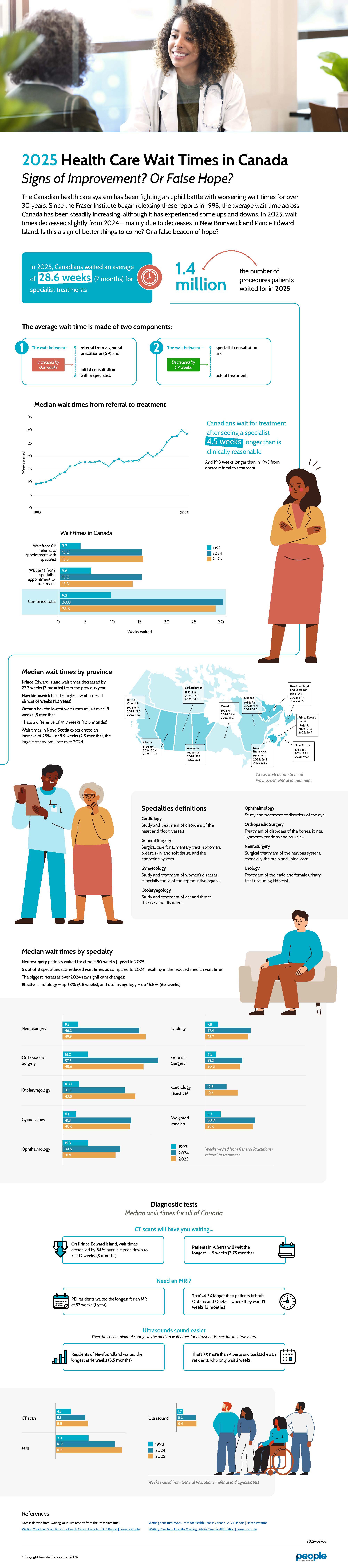
In 2025, Canadians waited an average of 28.6 weeks—just over seven months—for medically necessary specialist treatment. That’s a reduction from 2024’s staggering 30‑week average.
Behind that modest improvement were two key shifts:
- GP to specialist wait times increased by 0.3 weeks
- Specialist to treatment wait times decreased by 1.7 weeks
This means specialists are treating patients faster once they’re in the system—but it’s taking longer to get that first consultation.
In total, Canadians were waiting for 1.4 million procedures in 2025.
And despite the small improvement, patients today still wait:
4.5 weeks longer than is clinically reasonable, and
19.3 weeks longer than they did in 1993
A Country Divided by Wait Times
Not all Canadians experience the system the same way. Provincial wait times vary dramatically—from some promising improvements to some troubling setbacks.
The biggest changes by province:
- Prince Edward Island saw the most dramatic improvement, with wait times dropping 27.7 weeks (7 months).
- New Brunswick now has the longest waits in Canada, at nearly 61 weeks—over one year.
- Ontario maintains the shortest waits, averaging 19.2 weeks.
- Nova Scotia saw the largest increase—25% growth, adding 9.9 weeks over 2024.
- Provincial averages (total wait from GP referral to treatment):
The difference between provinces is striking: the gap between the shortest and longest waits is 41.7 weeks, or more than 10 months.
Specialty Care: Where Patients Wait the Longest
Some fields are improving—but others saw significant setbacks.
Longest waits in 2025:
- Neurosurgery: nearly 50 weeks
- Orthopaedic surgery: 48.6 weeks
- Otolaryngology (ear, nose, throat): 43.8 weeks
- Where wait times increased the most:
- Elective cardiology: up 53%, adding 6.8 weeks
- Otolaryngology: up 16.8%, adding 6.3 weeks
Overall, five of eight specialties improved, contributing to the nationwide reduction.
Diagnostic Imaging: Mixed Signals
Diagnostic tests are a critical step in treatment, and wait times vary dramatically across the country.
CT Scans
- PEI: Wait times down 54%, now just 12 weeks
- Alberta: Longest waits in Canada at 15 weeks
MRI Scans
- PEI: Longest waits at 52 weeks—an entire year
- Ontario & Quebec: Much shorter at 12 weeks
Ultrasound
- Minimal change in recent years
- Newfoundland: Longest waits at 14 weeks
- Alberta & Saskatchewan: Just 2 weeks
So… Is Canada Turning a Corner?
The 2025 numbers offer a glimmer of hope—but not enough to declare victory. The national improvement was small and carried heavily by two provinces: PEI and New Brunswick. Meanwhile, other provinces saw increases, and many specialties continue to push patients past clinically reasonable timelines.
What the data shows most clearly is this:
- Canada’s system does respond when pressures shift
- But it remains unpredictable and deeply uneven across the country
Whether 2025 marks the beginning of a positive trend—or simply a temporary fluctuation—remains to be seen.
Get all the details—Download the infographic now!
2024 Health Care Wait Times in Canada (PDF: 571KB)
References
Data is derived from Waiting Your Turn reports from the Fraser Institute:
![[FREE DOWNLOAD] Group insurance Quick Tax Facts Guide for 2026](https://www.bbd.ca/wp-content/uploads/2026/02/Group-insurance-Quick-Tax-Facts-Guide-for-2026-Banner.webp)