


 Back
Back
What’s covered under public health care versus private plans?
By: Willow Munro | Tuesday March 31, 2026
Updated : Monday March 30, 2026

While all Canadian residents enjoy free health care, there are certain costs which are not covered. These costs fall to private plans such as employee sponsored benefits, or individual health insurance plans. When that isn’t available, the burden of cost goes to the patient.
So, how should Canadians coordinate public health care with private coverage, so they can make the best use of both?
Health care coverage in Canada can be complicated, especially if you are diagnosed with an illness or disease which requires high-cost drugs or robust care.
The Canada Health Act
Let’s start with the basics of how we ensure public care is equitable and inclusive. Each province manages their own health care system, using public funds from the federal government along with collected funds through taxes and employer fees.
The Canada Health Act has the following requirements that provinces must comply with to receive Canada Health Transfer (CHT) funds:
- Public Administration — Public health care insurance plans must be managed by a public authority on a non-profit basis.
- Comprehensiveness: All medically necessary hospital and physician services must be covered.
- Accessibility: Canadians must have reasonable access to insured health services without financial or other barriers.
- Portability: Coverage must remain intact when moving between provinces or traveling within Canada.
- Universality: All eligible residents are entitled to the same level of health care coverage.
These guidelines protect the system from misuse and help ensure fair and balanced health care coverage for all Canadians. CHT funds are provided to the provinces “on an equal per capita basis to provide comparable treatment for all Canadians, regardless of where they live.”
Coordinating public health care with private plans
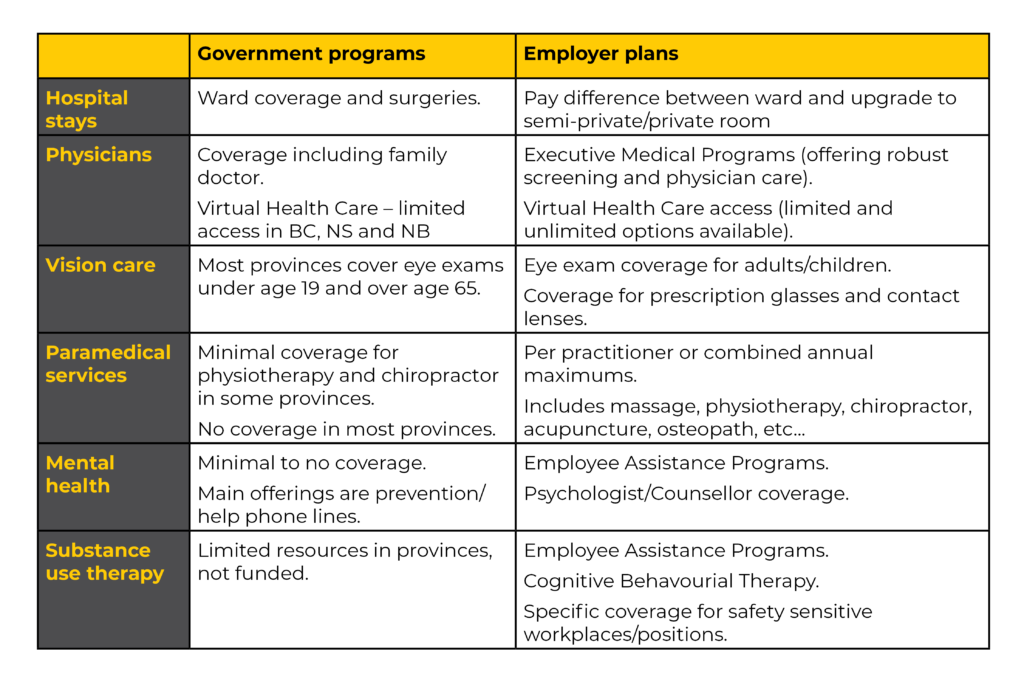
Employer and individual health insurance plans exist because the public system is not all-encompassing. Meaning that health care is free for basic needs, but certain costs are not absorbed, and there are low maximums or frequency limits. When the two plans are coordinated, Canadians get the most extensive coverage.
So, when do the private plans kick in?
Health coverage
Prescription drug coverage
Each province is also responsible for managing coverage for prescription drugs. Some have provincial pharmacare which covers specific drugs only. Coverage is available for retirees and low-income earners. However, these provincial pharmacare programs have income-based deductibles and limited drug formularies.
Group insurance coverage usually coordinates with provincial plans, and acts as secondary payor in cases where coverage is available through the government. However, employer sponsored plans usually offer broader, more thorough coverage, with small or no deductibles, with coinsurance ranging from 70% to 100%.
Interestingly, many employers are closing post-retirement benefit programs due to benefits being available under the public system, the rising costs of drugs, and the governance requirements.
Drugs that are specifically for weight loss are not covered under any public plans — yet. However, given the efficacy of GLPs for preventative care including obesity, heart disease and diabetes, and the release of generic options in the very near future, this could change in the future.
Employers have the option to add weight loss drug coverage, however, uptake has been slow as stigma and cost concerns continue to be a factor.
Lastly, fertility treatments and drugs are coverage varies by province:
- Quebec — one funded IVF between the ages of 18 to 41, including treatment and drugs
- Manitoba — 40% tax credit, including drugs, and subject to maximums
- Ontario — one IVF treatment under 43, excluding drugs
- British Columbia — eligible one time IVF up to $19,000, including drugs
- New Brunswick — up to $10,000 for IUI, and up to $20,000 for one IVF
Dental coverage
The government lauc hed the Canadian Dental Care Program in 2024, and has slowly been rolling out more coverage. To date, there are over 5 million Canadians accessing dental care through the program.
To qualify, you must have a net family income of less than $90,000 and no private insurance (including access to a health care spending account [HCSA]). There are also tiers based on income, which determine the coinsurance percentage.
Private plans typically offer 80% to 100% coinsurance for basic dental services, 50% for major and restorative services, and dependent orthodontic coverage. Over the last few years, however, more employers have extended orthodontic coverage to include adults with a lifetime maximum.
Navigating the mix of public health care and private coverage can feel complex, but understanding how the two systems complement each other helps Canadians make more informed decisions about their health needs. While public plans provide essential medical services and protect access for all Canadians, private plans step in to fill the gaps—offering broader coverage, enhanced benefits, and more flexibility in care.
By coordinating both systems effectively, Canadians can reduce out‑of‑pocket costs, access a wider range of treatments, and gain peace of mind knowing they are protected when unexpected health needs arise. As provincial programs evolve and employer offerings continue to adapt, staying informed about what’s covered under public health care versus private plans is the best way to ensure you’re getting the most from your benefits today—and well into the future.
Looking for more information on coordinating your benefits?
Coordinate your health and dental care plan with your health care spending account [Free infographic download]

![[FREE DOWNLOAD] Group insurance Quick Tax Facts Guide for 2026](https://www.bbd.ca/wp-content/uploads/2026/02/Group-insurance-Quick-Tax-Facts-Guide-for-2026-Banner.webp)